.png)

%20(1).png)
How much more could your team accomplish if you reduced stress-driven absenteeism?
When I speak with team leaders and project managers across organizations of all sizes, they often share their latest staff wellbeing ideas with me.
Lately, staff wellbeing has been at the forefront of their minds.
Why? Employee absenteeism is on the rise.
To combat this, the proportion of organizations with a wellbeing strategy has increased from 44% in 2020 to 57% in 2025.
Nearly two-thirds (64%) of organizations are taking steps to identify and reduce workplace stress, but only half (50%) of organizations overall think their efforts are effective.
This is likely because they are not seeing a meaningful decrease in employee absenteeism.
And honestly, I think they’re right to question their efforts around staff wellbeing initiatives.
It’s easy to throw together a few staff wellbeing ideas and tick some boxes, but if they’re not energizing and galvanizing employees, this won’t fix absenteeism.
Rather than throwing darts at random staff wellbeing ideas and hoping they improve things, I want you to:
If, after you’ve scrolled through this article, you feel relieved to finally have a sustainable way to improve staff wellbeing, take it as your sign to start your four-week free trial of Water Cooler Trivia.
Before diving into what works in 2026, I want to call out the wellbeing “solutions” that often fail to have any real impact.
In my experience, these are some of the worst options for staff wellbeing:
If you’re entertaining any staff wellbeing ideas that sound like the above, I recommend hitting the brakes and taking a different route.
The wrong idea can push people further into fatigue, which is why I want us to focus on staff wellbeing ideas that actually work.
So, what staff wellbeing activities are actually getting results?
Water Cooler Trivia delivers the goods.
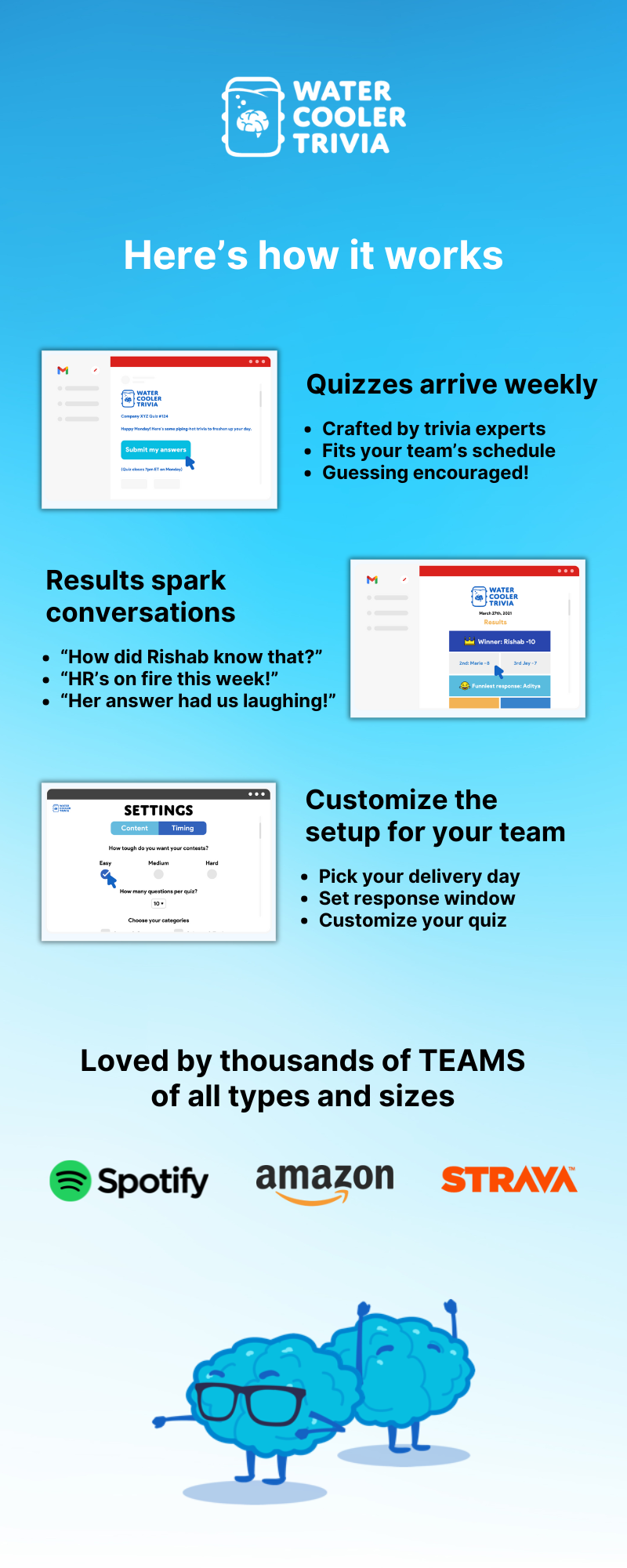
Teams naturally get weighed down as the week goes on, so Water Cooler Trivia gives them a mid-week boost.
I like to think of it as the perfect Wednesday reset.
In under 10 minutes, it gives people something light, fun, and unexpected to focus on, without turning it into a heavy wellness initiative.
You can run quizzes through email, Slack, or Teams. People answer whenever they want, or you can take the quiz together live.
.png)
When I check in with leaders to see how they’re getting on with Water Cooler Trivia, they tell me it’s the one activity their teams actually look forward to.
Why’s this important?
Teams with something to look forward to each week are less prone to unnecessary absenteeism.
They’ll also form stronger bonds with co-workers, which I’ve found is often an effective buffer against burnout.
As a leader, I want you to ask yourself…
If a 10-minute ritual could increase happiness, reduce tension, and create connection all year long… why wouldn’t you try it?
Start your free four-week trial of Water Cooler Trivia.
Once you’ve set a clear absenteeism-reduction target to anchor your efforts, you can begin implementing high-impact, low-cost activities that move the needle.
I’ve already told you about Water Cooler Trivia, but it bears repeating…
My team of trivia nerds is ready to write quizzes tailored to your co-workers’ interests.
Yes, we write trivia questions that turn the heads of even the most reluctant participants.
Intrigued? You have absolutely everything to gain and nothing to lose by trying Water Cooler Trivia free for four weeks.
This one makes me laugh because even the tiniest victories people share often remind the whole team that progress is still happening, which boosts momentum on tough weeks.
I’ve found that opening a meeting with two minutes of good news stabilizes morale, so small frustrations don't snowball into stress-driven days away from the office.
As a team, we sometimes forget how much everyday help matters, and calling it out weekly builds a steadier emotional climate during busy seasons.
I've learned from teams with a dedicated Slack meme channel that sharing humor acts like a release valve for many people. They feel it interrupts any accumulation of stress or tension.
There’s always time for a quick celebration when a milestone is reached. Stick on some music and let those you’re celebrating take their victory lap around the office.
I like this one because shared playlists bring a bit of personality into routine meetings, which lightens the overall atmosphere on heavy project weeks.
I know what you’re thinking… this is super cliche. I actually think these short, unstructured chats are immensely valuable.
They often lead to surprising discoveries that make work feel less isolating, especially as co-workers begin to build rapport and you start seeing the compounding effects of these chats over week and months.
If your team loves talking about their pets, offer them a dedicated time to introduce their companions!
Unless you want pets roaming around the office, these showcases are best conducted on Zoom with remote employees.
I tend to center this classic icebreaker around specific themes (like travel, food, or childhood stories) to add just enough novelty. It’ll lift everyone's mood before diving into tasks.
As a team, we sometimes need a visible reminder of what's going well, and a kudos wall creates steady reinforcement during busy, intense periods.
When I talk to leaders about this one, they say spotlighting a customer win helps people reconnect with the impact of their work, which eases pressure.
Organize a random monthly drawing where the winner receives a complimentary lunch.
If you’re not sure about the lottery angle, you could just treat the entire team to a free lunch either during or after a busy workweek.
This one makes me laugh because simple themes like Hat Day or Team Color Day (where everyone wears a specific color) reliably lift the team's mood without derailing productivity.
This type of activity is particularly effective when you cannot set aside time for a more involved team morale booster.
I've found that jotting down a quick moment of gratitude creates a small psychological buffer that helps people cope better with demanding workloads.
Rotate the responsibility for a pre-meeting DJ. This means assigning one team member to select and play background music for 5-10 minutes before the official start of a meeting.
Introduce quick, wellness-focused prompts for the team, such as a 10-minute walk or a hydration challenge.
These micro challenges are excellent for hitting the mental refresh button and helping team members regain focus and maintain their energy throughout the day.
I recommend testing these at different times of the day. A impromptu mid-afternoon challenge could offer a much-needed boost.
Use a dedicated Slack channel or thread to prompt daily or weekly emoji check-ins.
This nudges team members to quickly acknowledge their current stress or mood levels, making it easier for them (and management) to address issues before they escalate.
When I talk to teams about this ritual, they say sharing both the highs and the lows keeps frustrations from lingering into the next week.
I like this one because giving the team time back when they hit goals early creates a powerful incentive structure.
When it’s a Friday and you’ve come to the end of a big project, this seems like a no-brainer.
.png)
It is increasingly clear that leaders cannot effectively tackle employee turnover and absenteeism without a comprehensive staff wellbeing strategy.
The organizations that successfully reduce these issues do so by implementing a combination of micro and macro changes to their overall workplace culture.
Staff wellbeing activities, like the ones I’ve mentioned above, certainly have an important role to play.
They can provide necessary support, boost morale, and introduce positive habits.
But they aren't the only answer.
True, sustainable change will come from adopting a well-rounded strategy that addresses systemic issues alongside individual support.
Easy-to-implement micro-changes build momentum and cultural buy-in.
Try Water Cooler Trivia with a four-week free trial on us.