.png)

%20(1).png)
How much more productive could your team be if communication breakdowns no longer derailed entire workdays?
When I speak with department heads, team leads, and project managers, they often tell me about their latest attempts at setting up team communication games.
Here’s what we know:
From what I’m seeing, the urgency to improve communication has reached a new peak.
This is because miscommunication is costing teams time and money.
Sure, this has always been the case, but with more teams collaborating across time zones, screens, and channels, the impact of unclear communication becomes harder to ignore.
Even with managers investing more time in communication training, many still tell me they are not seeing enough progress.
They are right to feel stuck.
Yes, you can put together a few team communication games and hope for the best, but I rarely see this work.
If these games aren’t grounded in strengthening team bonds and breaking down barriers between co-workers, they will not change anything.
This is why I want you to be intentional about the team communication games you pick.
Here’s where you start:
If, after you scroll through this article, you feel relieved to have a clear plan for upgrading team communication, treat it as your sign to start your four-week free trial of Water Cooler Trivia.
Before I talk about what works in 2026, I want to mention three types of team communication games that rarely move the needle.
These are the least effective options:
If you are considering games that sound like any of the above, put those to one side.
I have a different solution for you…
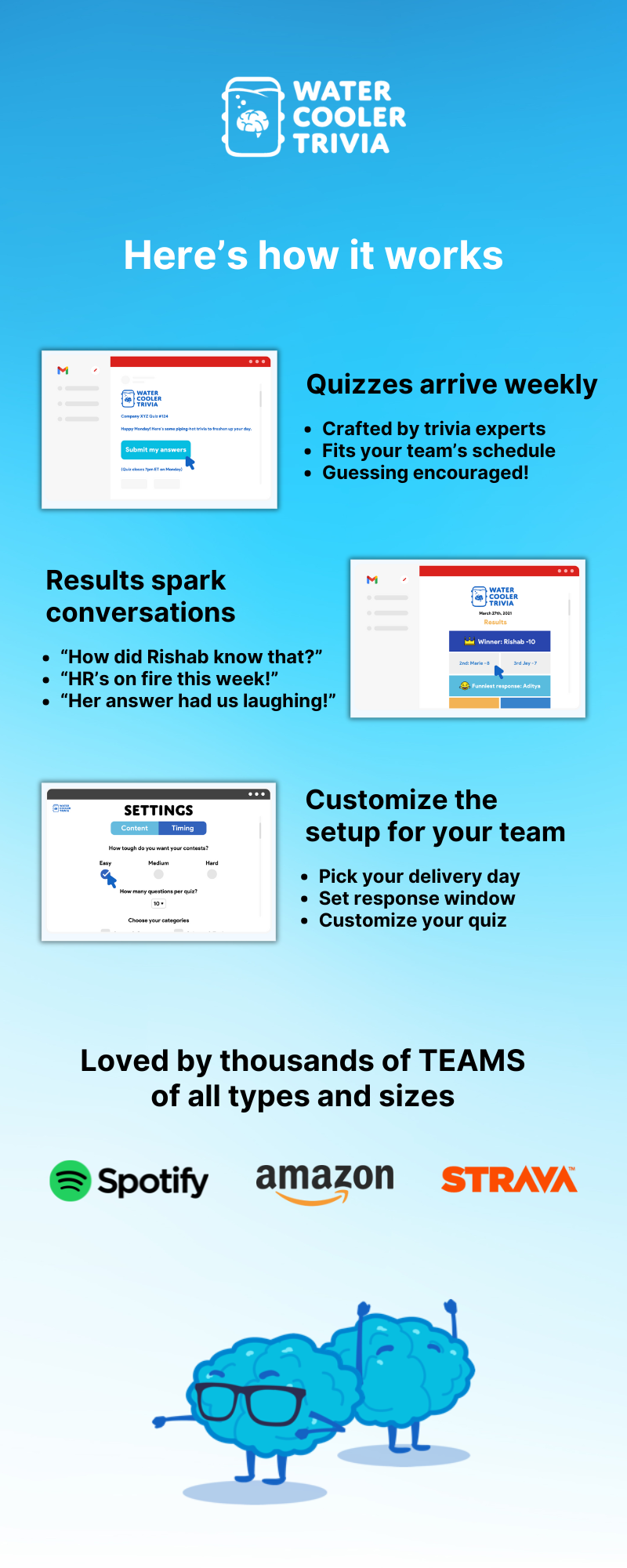
Water Cooler Trivia is the essential weekly ritual your team needs.
As the demands of the week accumulate, communication often becomes strained or purely transactional.
Our trivia platform delivers a moment of guaranteed shared fun and lighthearted interaction every single week.
In less than 10 minutes, the quiz offers an engaging, low-effort prompt that naturally encourages curiosity, easy reactions, and meaningful dialogue among teammates.
I want you to stay away from forced “team building” and training.
Water Cooler Trivia is a different beast.
You can run quizzes via email, Slack, or Teams.
.png)
Participants can answer asynchronously on their own time, or the entire team can tackle the questions live together.
When I speak to leaders about their experiences with Water Cooler Trivia, they often share examples of how it’s built rapport among co-workers who wouldn’t usually communicate about anything beyond project deadlines.
Teams with a healthy foundation of casual communication tend to do better at formal communication.
Trivia provides the ideal low-pressure environment for people to connect easily.
Here’s my question for you…
If a simple 10-minute ritual could consistently boost conversations, ease friction, and strengthen team communication throughout the year... isn't it worth a try?
Begin your four-week free trial of Water Cooler Trivia today.
If I were in your shoes, I’d recommend picking a few games from my list below and giving them a go with your team.
As I mentioned earlier, after a week or so, you can send a survey to team members to collect quantitative and qualitative feedback on communication.
You can use this data to decide whether to continue with your team communication games or try others.
Yes, I’m biased, but Water Cooler Trivia is the best place to start for most teams.
My trivia nerds will write themed questions to spark conversations even among the quietest participants.
Employees can form small groups to take part in the trivia quizzes, and it’s the interactions they’ll have with each other in these groups that make the game worthwhile.
You have everything to gain and nothing to lose by trying Water Cooler Trivia free for four weeks.
This rapid-fire exercise challenges the team to construct a coherent sentence, one word at a time.
The icebreaker demands intense active listening from every participant, as the group must constantly adjust its contribution based on the very last word.
Okay, maybe this isn’t a game, but I still think it’s useful.
At the start of a weekly meeting, each person shares a single word describing how they’re feeling.
A quick optional follow-up allows teammates to clarify if something is affecting their workload or communication.
This means co-workers have a little bit of human connection before getting stuck into tasks.
Provide a simple task (such as drawing a shape or assembling a Lego model) but give intentionally incomplete or ambiguous instructions.
Then discuss what caused confusion.
This game directly surfaces communication gaps and helps teams see exactly how assumptions derail productivity.
Participants anonymously share a cropped or zoomed-in photo of their workspace, and everyone guesses whose desk it is.
It’s a playful, low-effort game that breezes past formal roles and starts encouraging natural conversation among coworkers.
.png)
You give two groups the same set of materials and a single written instruction. They build separately, then compare results.
It’ll show how differently people interpret the same message.
You assign a teammate to give instructions for a random office-based task using only emojis.
Watching others interpret them opens the door to better communication habits.
Someone introduces a familiar tool or process as if the team has never used it before.
The rest of the team can ask basic questions to clarify steps.
You’ll find that the exercise exposes assumptions that often hinder onboarding and internal communication.
Create a short fictional email or project brief that’s littered with subtle miscommunications or unclear instructions.
In small groups, your team can work together to identify and rewrite the problem areas.
This is designed to sharpen communication instincts and help employees spot ambiguity early.
Instead of drawing a picture, the “artist” on your team describes an image without revealing what it is, and everyone else draws based solely on the verbal cues.
Again, this is another game that should break the ice and help co-workers practice communication skills.
.png)
Every team I work with agrees that communication problems are rarely about talent or intention.
Your co-workers just need to get in sync with one another.
Team communication games like the ones above help a great deal.
They instantly rebuild the trust and understanding required for high-speed alignment.
Try Water Cooler Trivia with a four-week free trial. See the shift in your team's energy by the end of the first week. Zero risk. Massive upside.