.png)

%20(1).png)
What if everything you think you know about how to manage teams remotely is based on an outdated playbook that's actively hurting your team's performance?
I've spent the last few years talking with remote team managers, and honestly, most of them are exhausted. Not necessarily from the work itself, but from feeling like they're managing in the dark.
They tell me things like, "I don't know if people are struggling until it's too late," or "My team feels disconnected, and I'm running out of ideas."
Does this sound familiar?
Here's what the data shows us:
The thing is, remote work isn't the problem. Bad management is!
I see too many leaders trying to recreate the office experience online and it never works. You can't just transpose in-person tactics to Slack and expect the same results. Managing remotely requires a completely different mindset. You need to be more intentional, visible, and human, not less.
If you aren’t seeing the results you want from your remote team, it probably has something to do with the strategies you’re using.
Stick with me until the end and I’ll share a solution with massive upside and no risk. That’s right, it’s not going to cost you anything. Everything to gain and nothing to lose.
I want to start by calling out the approaches that sound logical but always seem to backfire. These are the strategies I see failing teams over and over.
Nothing destroys trust faster than anything else I've witnessed. Monitoring software that tracks keystrokes or screenshots makes your team spend more energy appearing busy than actually being productive. Your people will resent you for it… and productivity will crater.
Just because someone isn't messaging you doesn't mean they're crushing it. They might be stuck, confused, or burned out, and you won't know until it's too late. In remote work, I’ve found that silence often signals struggle. Check in!
This sounds reasonable until your team develops meeting fatigue. More meetings don't equal better management. They equal exhaustion and resentment. Your team doesn’t need another Zoom call to discuss what could have easily been covered in an email.
This ignores the reality that remote work affects people differently. Some thrive with autonomy while others need more structure. One-size-fits-all management won’t work when people are navigating vastly different home environments and personal circumstances.
In an office, you might notice someone's off because they're quieter than usual or look stressed. Remotely, you have to actively create space for those signals to emerge or they'll stay hidden until someone quits or burns out.
I'm telling you this because I've watched managers dig themselves into holes with these tactics, then wonder why engagement is tanking. It’s frustrating to see.
If a 10-minute weekly ritual could rebuild the casual connection your remote team is missing, wouldn't that be worth trying?
I need to tell you about something that's solving one of the biggest remote work challenges, which is the loss of casual connection.
If you want to learn how to manage teams remotely, you must nip it in the bud before it becomes a problem.
In an office, people bond over coffee runs and random hallway conversations. Remote teams don't get those moments unless you intentionally create them… and most managers struggle to manufacture authentic connection.
With Water Cooler Trivia, every week, remote teams have a shared experience that’s… just fun.
For a few minutes, our trivia quizzes take them away from worrying about deadlines, deliverables, and performance reviews.
Teams can answer questions asynchronously through email, Slack, or Teams at a time that works for them. Or you can hop on a quick call and tackle it together live.
The beauty of this is that it takes less than 10 minutes, but the ripple effects last all week.
Here’s what team leaders and managers notice:
I've had remote managers tell me it's the one thing their team actually looks forward to each week, and that consistency matters more than they initially realized.
Why does that matter? Because remote teams with strong informal bonds communicate better, collaborate more effectively, and stay longer. The soft skills that develop through casual interaction directly impact hard business outcomes.
Start your four-week free trial of Water Cooler Trivia today.
.png)
Alright, let's get into the strategies that are getting results for remote managers in 2026. These are practical, tested approaches you can start implementing immediately.
Yes, I'm starting here again because it works. My team writes custom trivia quizzes that spark conversation, even among the most reluctant participants!
Remote teams especially need this kind of low-pressure interaction. It breaks up the week and reminds everyone they're part of something bigger than their individual tasks. Try it free for four weeks. You've got nothing to lose and everything to gain.
Have each team member post a quick update in a shared channel covering what they're working on, what's blocking them, and one thing they need help with. This keeps everyone aligned without requiring meetings. It also surfaces issues early before they become crises.
Why not set aside specific times each week where you're available for anyone to drop in? Some people will never use it, but others will treat it like a lifeline. Ultimately, both outcomes are valuable because it shows you're accessible.
Record a 2-3 minute video updating the team on priorities, wins, or just checking in on how everyone's doing. Video feels more personal than email and doesn't require everyone to be online simultaneously. I've seen this single change improve how present managers feel toward their teams.
Create a dedicated channel or thread for shoutouts. Encourage peer-to-peer recognition, not just top-down praise. Remote workers often feel invisible. Regular acknowledgment combats that in a way that email kudos never quite manage.
Once a month, schedule individual 15-minute calls with each team member that have nothing to do with work performance. Ask about their setup, workload, and energy levels. Actually listen to the answers and follow up on what they tell you.
In remote work, saying “I mentioned that in the meeting” doesn't cut it. Everything important needs to be written down somewhere accessible. Create a knowledge base that helps prevent miscommunication. We all know that miscommunication is often a major source of anxiety for teams. Make documentation a cultural norm.
Use a shared board where everyone can see what others are working on and how projects are progressing. Transparency builds trust and helps people feel less isolated in their work. It also prevents duplicate efforts and clarifies priorities.
Start each week with a brief message or quick call that frames the week ahead. Keep it energizing. Remote workers need help creating structure when there's no physical office to anchor their week.
Not every creative discussion needs to happen in real-time. Use collaborative docs or boards where people can add ideas on their own schedule. This also gives introverts and people in different time zones an equal voice in the conversation.
Let different team members lead weekly check-ins or project updates. It distributes responsibility and helps everyone develop leadership skills. You’ll find that it also prevents you from becoming the single point of connection for the entire team.
Protect certain hours each week where no meetings are scheduled and everyone can focus without interruption. Remote teams need this even more than office teams because the digital distractions are endless.
Pair every new remote team member with a veteran who can answer the stupid questions they won't want to ask you. Remote onboarding is brutal without this kind of informal support. New hires need someone who remembers what it's like to be confused.
Every month or quarter, ask the team what's working and what's not. Then, actually implement the feedback. Remote teams need to see that their input shapes how things run, or they'll stop offering it.
Give people permission to turn cameras off during meetings when they need to. Not everyone is comfortable on camera all the time and forcing it creates unnecessary stress. Focus on participation. The “performance” element doesn’t matter.
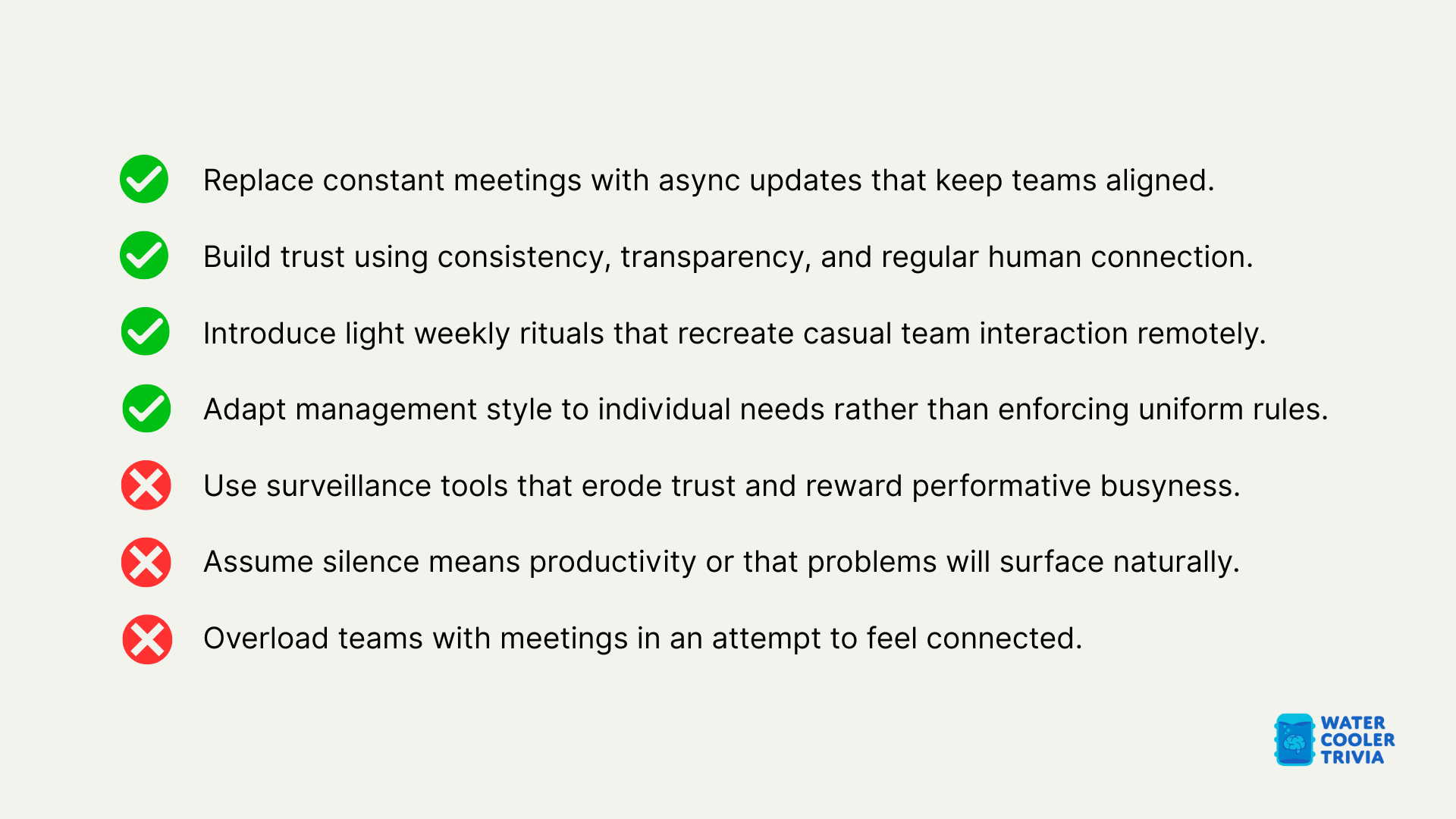
Here's what I want you to understand about managing remote teams…
You can't manage what you can't see, so you need to create visibility without the surveillance stuff!
That means building systems where information flows naturally. You want people to feel comfortable speaking up.
It also means accepting that remote management requires more intentionality than office management ever did.
You can't rely on proximity to build trust. You have to earn it through…
The casual interactions that used to happen automatically now require deliberate effort.
The managers who succeed with remote teams are the ones who stop trying to replicate the office and start designing something better. They create rhythms instead of rigid schedules. They prioritize outcomes over activity. They build culture deliberately, not accidentally.
Most importantly, they stay curious about what their team actually needs, and they're willing to experiment until they find what works. Remote management isn't a problem to solve once. It's an ongoing practice of adjustment and improvement.
Of course, you can't! Why? Because remote work isn't going back to what it was. Teams are distributed and work is asynchronous. The old management playbook doesn't apply anymore.
You can keep struggling with outdated strategies or you can start building the systems and habits that actually support remote teams.
The managers I admire most are the ones willing to try new approaches, learn from what doesn't work, and keep showing up for their teams.
Remote management is hard but it's also an opportunity to build something more sustainable than traditional office culture ever was.
I want you to start small. Pick one or two strategies from this list and test them for a month. Gather feedback. Adjust. Repeat.
And if you want an easy win that takes less than 10 minutes a week but creates genuine connection across your remote team, try Water Cooler Trivia with a four-week free trial. See what happens when your team has something to look forward to together.